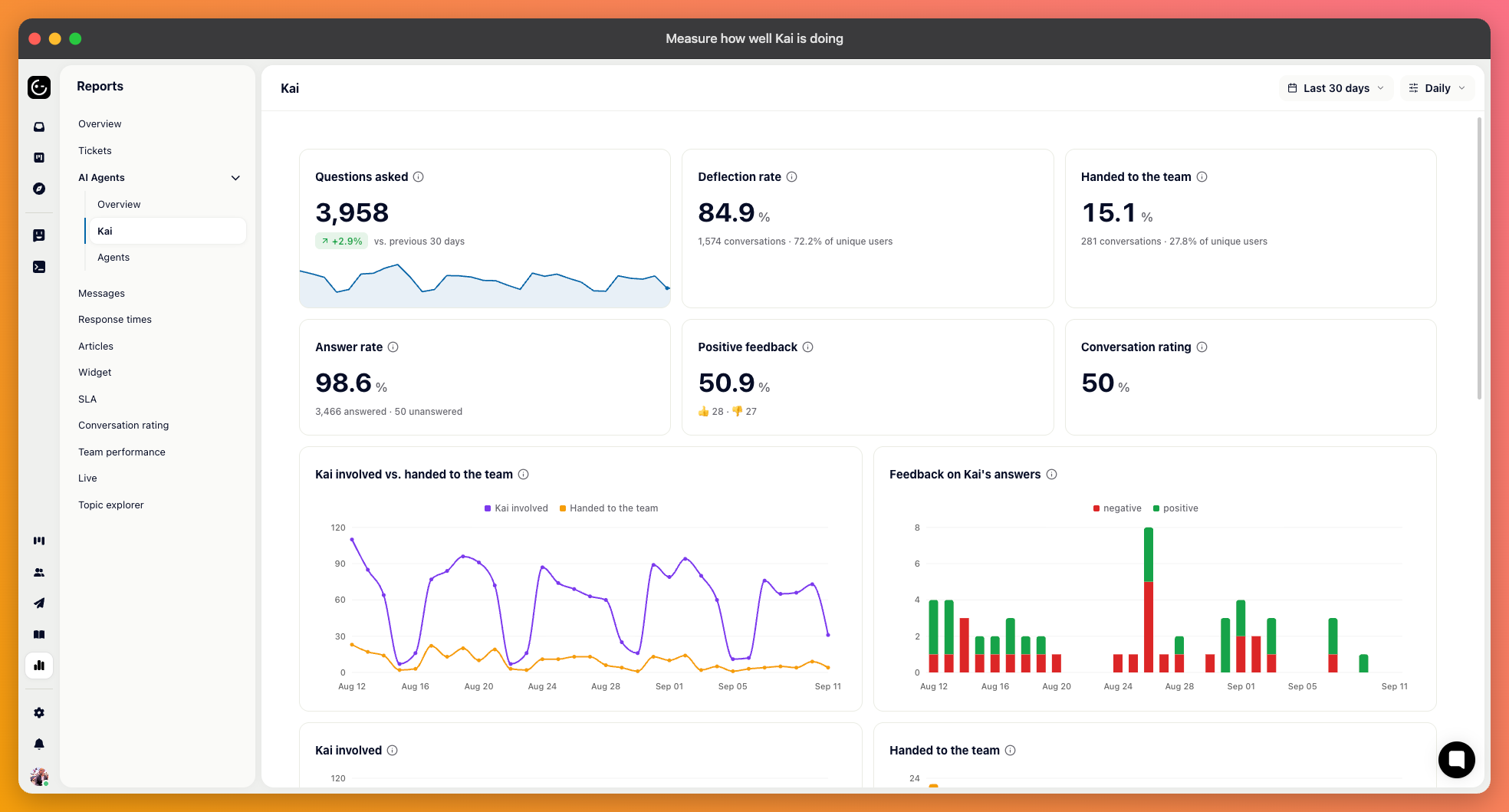
Open Reports, go to Customer support and select Kai. Everything below is on that page.
Of the conversations Kai took part in, the share that never turned into a request for a human. If Kai was involved in 100 conversations and 20 of them ended up asking for support, deflection is 80%.
Its counterpart, the routed-to-agent rate, is the same population seen from the other side: how often a conversation did reach your team. Both are also shown as plain counts, which are easier to sanity-check against your inbox.
Each rate comes in two versions. The total rate counts conversations. The unique-sessions rate counts people, so someone who came back five times counts once.
They diverge in a way worth noticing. If the total rate looks healthy but the unique-sessions rate is markedly worse, a small group is coming back repeatedly and not getting what they need — which the conversation-level number hides.
Two counts sit next to the rates: how often Kai produced an answer, and how often it found nothing and said so. The second is the more useful of the two. It's a direct measure of gaps in your content, and it goes down when you write, not when you change settings.
There's also a count of questions asked, which tells you whether people are using Kai at all. A low number here means the problem is placement, not quality.
Where you let customers rate an answer, you get positive and negative counts, the positive percentage, and a chart of ratings over time. Below those sits a list of the most recent negative ratings.
That list is the most actionable thing on the page. Each entry is a real question where the answer missed, which is a far better guide to what to write next than any aggregate.
Deflection on its own is a misleading target. A customer who gives up and closes the window counts as deflected just like one who got a good answer, because neither asked for a human. Pushed hard enough — by making it difficult to reach a person — deflection goes up while your support gets worse.
Read it alongside the rating percentage and the no-answer count. Deflection rising while ratings hold steady is genuine progress. Deflection rising while ratings fall means people are giving up rather than being helped.