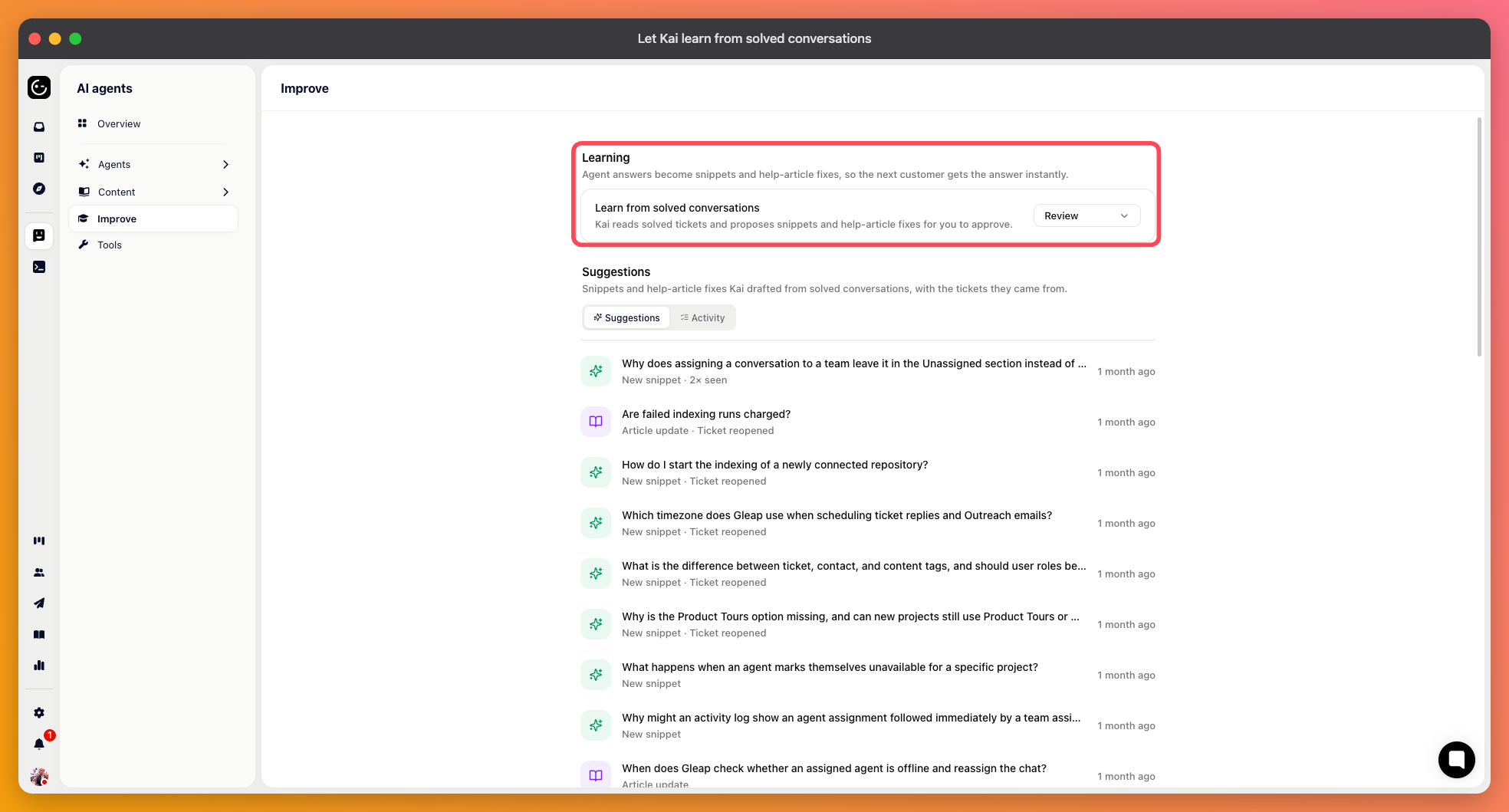
Your team answers good questions well every day in the inbox, where the AI can't see them. This is the feature that moves those answers into knowledge without anyone sitting down to write documentation.
Open AI agents and go to Learn. It has two tabs: the suggestions waiting for you, and a record of what has already been applied.
When a ticket closes, the conversation is examined for knowledge that would help other customers — not the specifics of that one case, but the general fact behind it. Most tickets produce nothing, which is the expected outcome.
Only conversations a person actually answered are considered. Threads the bot handled on its own, and tickets answered purely from knowledge you already have, are skipped deliberately: a knowledge base that learns from its own output drifts, and each pass makes it more confident about whatever it got wrong first.
Three kinds of change: a new snippet, an edit to an existing snippet, or an edit to an existing article. It won't write you a whole new help article — those stay yours to write, and a snippet is the right size for a fact learned from one conversation anyway.
Each suggestion shows what it proposes and the ticket it came from. You can approve it as it stands, edit it first, or dismiss it.
Editing before approving is worth the extra few seconds. An answer written to one customer often carries their circumstances in it, and generalising the wording is exactly the work that makes it reusable.
You can also let suggestions apply themselves. Before deciding, it's worth knowing what autopilot will and won't do on its own.
Only high-confidence suggestions drawn from what a person actually wrote can apply automatically.
Anything derived by AI rather than written by a teammate is held back for review, whatever else is true about it.
Anything that looks like it contains personal data is routed to a human as well.
So autopilot is narrower than it sounds, and the cases it takes on are the ones where a reviewer would almost always have said yes. Even so, read the activity tab for the first few weeks.

The quality of what you're offered depends on how your team writes in the inbox. A reply that explains the rule — “exports only include the columns visible in your current view” — becomes reusable knowledge. “Fixed it for you, try again now” contains nothing anyone else can use.
If the queue is consistently empty, that's usually the reason, and it's a more useful thing to work on than any setting on this page.