Custom AI Agents are purpose-built AI assistants you design from the ground up. Where Kai is your knowledge-based chatbot — trained on your help articles and content to answer questions — custom AI Agents are different: they're dedicated agents you build for a specific job, each with its own instructions, tools, model, and behavior.
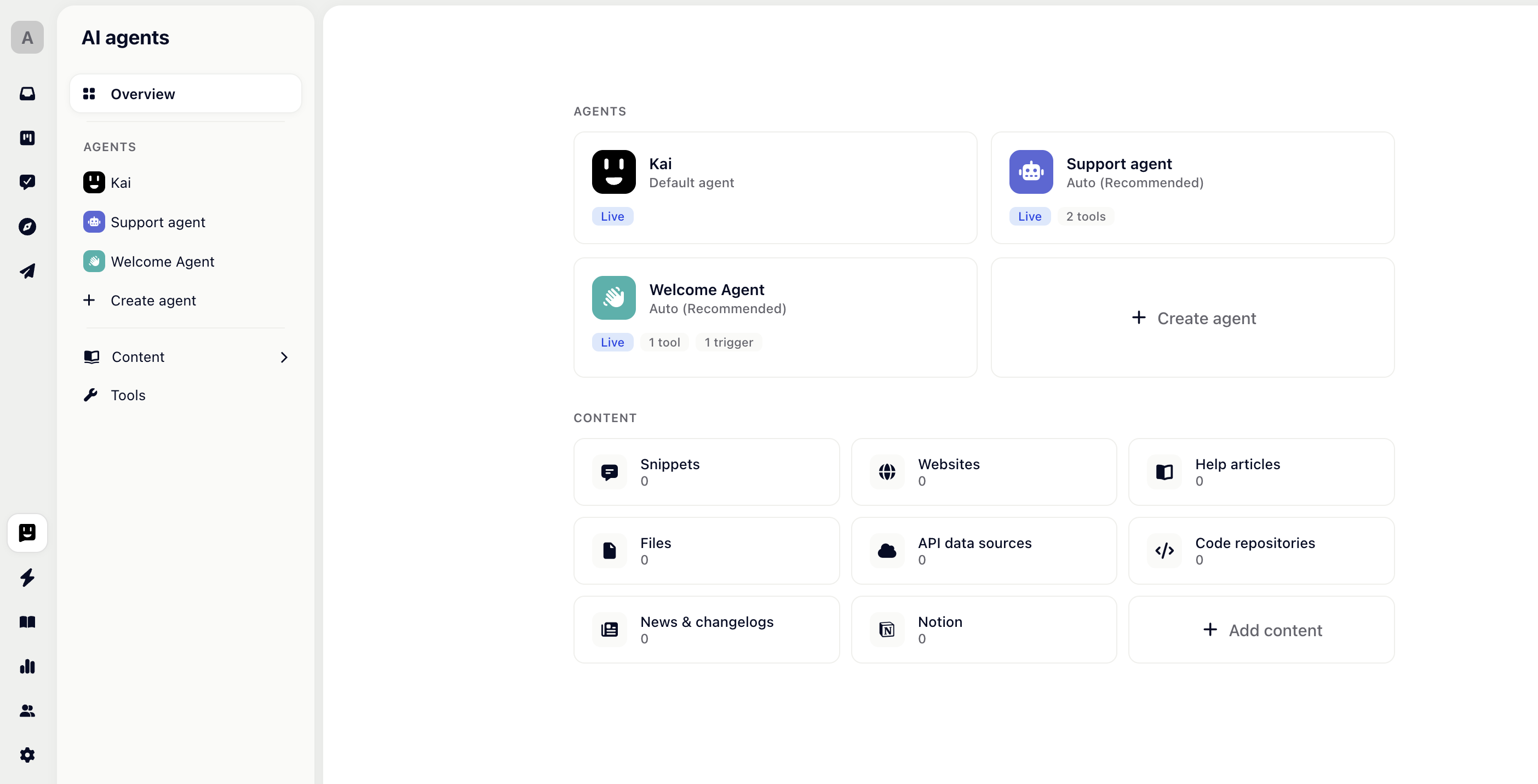
A simple way to think about it:
Kai answers questions from your knowledge base.
Custom AI Agents do work. They follow your instructions, call APIs, hand off conversations, run on a schedule, and coordinate with other agents.
You can build an agent for almost any job. A few common patterns:
Specialized support — a billing-only agent, a tier-2 technical agent with access to internal APIs, a refunds agent with tightly scoped permissions.
Internal operations — a release notes drafter, an on-call triage helper, or a customer summary agent your team triggers on demand or on a schedule.
Outbound and proactive — agents that follow up with users, qualify leads, or watch for signals and act on them.
Workflow automation — agents that execute multi-step processes through tools (API, MCP, Composio) — for example, creating a ticket from a conversation or syncing data to HubSpot.
Every custom AI Agent is built from the same set of building blocks:
Instructions — the system prompt that shapes how the agent thinks and behaves.
Model — the LLM that powers the agent.
Personalization — name, icon, and color so users recognize who they're talking to.
Quick actions — predefined prompts users can click to trigger common tasks.
Tools — capabilities like API calls, web search, MCP servers, handoffs, and delegation that let the agent take action beyond chat.
Triggers — how and when the agent runs: manually, via API, on a schedule, on Gleap events, or through Composio integrations.
Access control — who can use the agent: everyone, only the creator, or specific users.
Now that you've got the big picture, dive into the building blocks:
Building your agent — configure instructions, model, and conversational behavior.
Tools — giving your agent capabilities — extend what your agent can do.
Triggers — when and how agents run — control when your agent activates.
Multi-agent collaboration — connect agents through handoffs, delegation, and human escalation.
Going live — access, webhooks, and monitoring — ship your agent and track its runs.