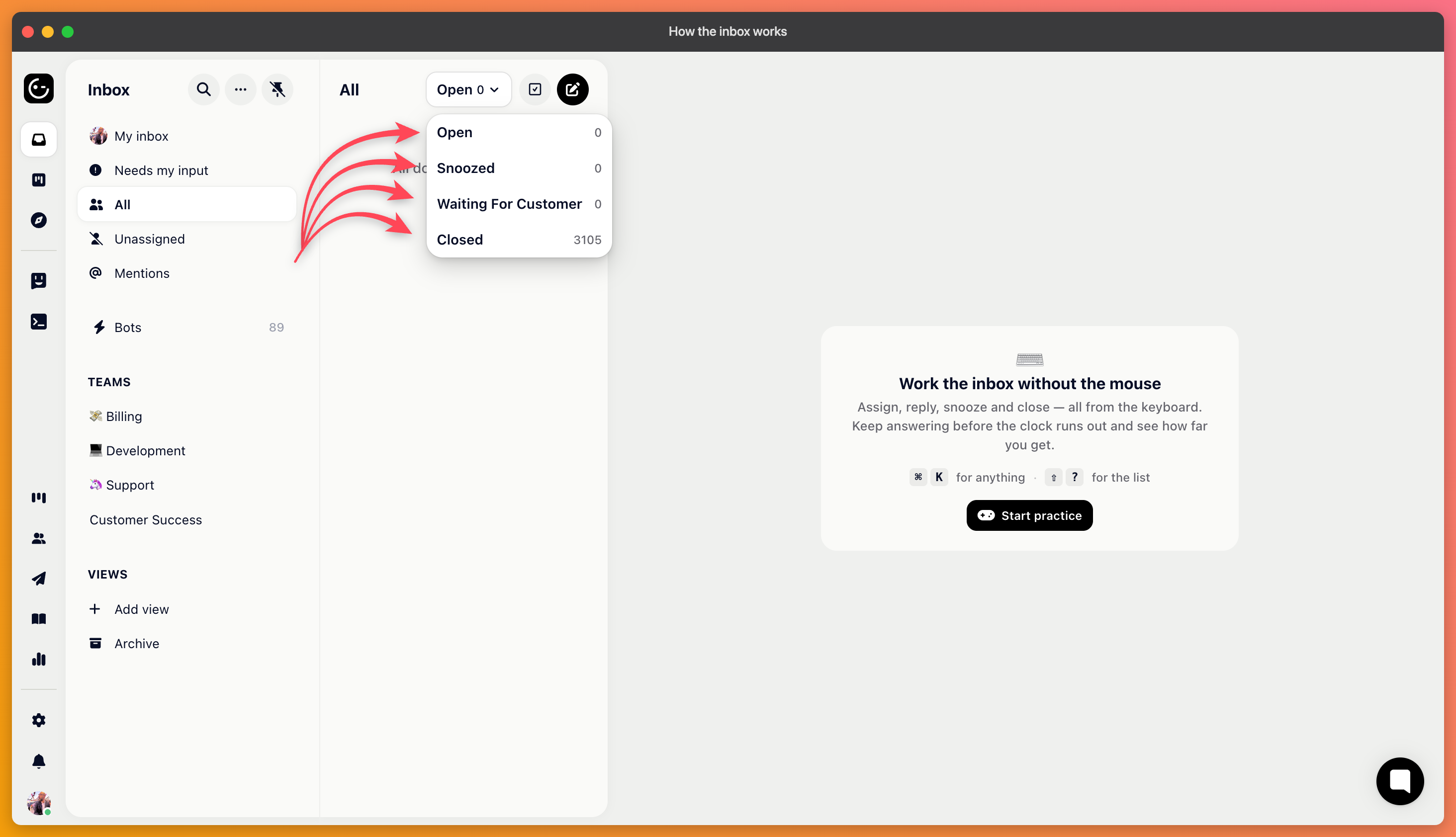
Everything a customer sends becomes a ticket, whichever channel it came from. How that ticket is organised comes down to two things: its type, and which status lane it sits in.
A new project starts with three types, and they behave differently on purpose.
Inquiry — shown as an inbox, the way you'd read a mailbox. Conversations arrive, get answered, get closed.
Bug — shown as a board with columns, because a bug moves through stages rather than being answered once.
Feature request — for things customers want, which get collected and weighed rather than resolved.
You can add your own types, and each gets its own view, its own lanes, and its own confirmation email. That's what keeps a bug report from cluttering the queue your support team works through.
Each type has its own set of lanes, and they differ because the work differs. Inquiries move through Open, Snoozed, and Done. Bugs get Open, In progress, To test, and Done.
Lanes are yours to change. You can rename them, add stages your process needs, or remove ones you never use — and each lane has an internal key alongside the name you see, which matters when you're filtering or working through the API.

A ticket can be assigned to a person or to a team. Unassigned tickets belong to everyone, which in practice often means nobody — so most teams either assign as they pick things up or let routing do it automatically.
Assigning is also what makes the numbers mean anything later. Response times and workload per person are only as good as the assignment behind them.
Moving a ticket to Done closes it. That isn't only a status change: closing is what can trigger a satisfaction survey, and it's what makes the conversation a candidate for the content suggestions that turn good answers into knowledge.
So closing properly is worth the discipline. A queue where tickets are abandoned rather than closed produces no satisfaction data, no learning, and no reliable resolution numbers.
What happens if a customer replies after you've closed a ticket depends on a project setting. With "Move ticket to Open when a customer replies to a closed ticket" turned on, the conversation reopens rather than starting fresh — so closing something that turns out not to be finished isn't a mistake you have to avoid. That option is off by default, so switch it on first if you want to rely on it.